Why Ham Radio Is Not Plug and Play (And What Both Ends Need to Talk)
Friday, November 20, 2026
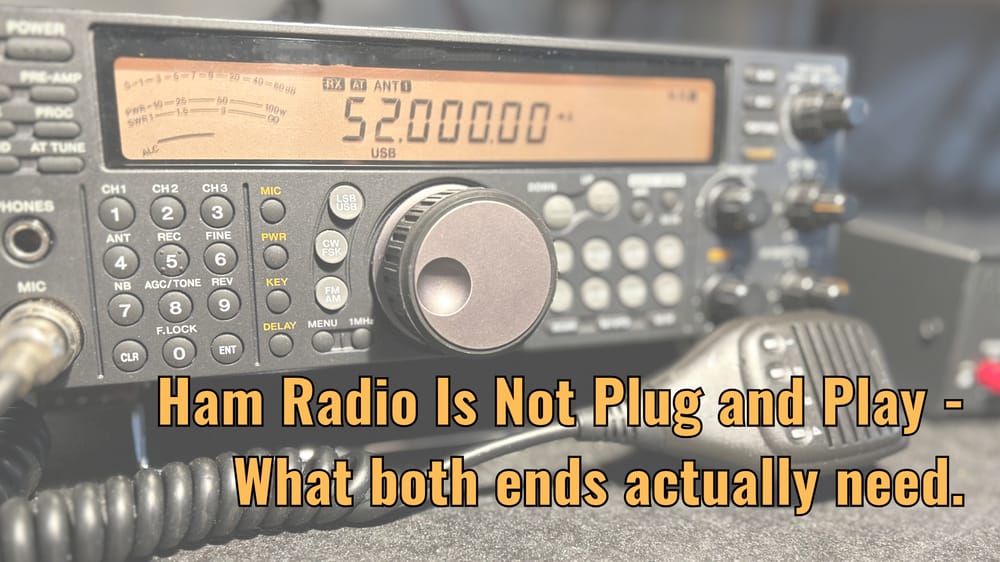
Ham radio is not plug and play. To talk with another person, you both need a radio that works on the same band and mode, a license that lets each of you transmit there, and a path for the signal to travel. A $20 walkie-talkie from Amazon will not talk across the country, and neither will a $2,000 radio if the person on the other end cannot hear you and answer.
A phone works because a network sits in the middle. You buy the device, pay the bill, and the network connects you to anyone. Radio does not work that way. Most of the time it is your radio, their radio, and the air between them. If either end is missing something, nothing connects, and the radio will not tell you why.
I'm Caleb Nelson, K4CDN. I have been a licensed ham for more than 15 years and have spent more than 30 years in fire and emergency services. Here is what both ends actually need, in plain terms.
What Both Ends Need
For two people to talk, four things have to line up on both ends:
Notice what is not on the list: the same brand. Matching means matching capability. A $30 radio and a $1,500 radio talk to each other fine if they are on the same band and mode, and both people are licensed to use it.
Why a $20 Walkie-Talkie Will Not Talk Across the Country
A $20 walkie-talkie is built for short distances. License-free FRS radios transmit at 2 watts or less, and a handheld's antenna is permanently attached. In normal conditions, with a few trees and buildings in the way, expect about half a mile to a mile. I cover those radios in GMRS vs FRS vs MURS.
A cheap ham handheld works the same way. It talks on VHF and UHF, so it is a local radio. Those signals mostly travel in straight lines, and the Earth curves away underneath them. Across a town, a county, or a few miles of farm, a matching pair of handhelds can do the job. Their reach beyond that comes from a repeater on a hilltop or tower, not from the radio in your hand.
What It Takes to Talk 1,500 to 2,000 Miles
To go that far without towers, you use HF. HF signals bounce off the ionosphere, which is how a station in one state can hear a station 1,500 to 2,000 miles away. On 40 meters that kind of distance is typical at night. During the day, 40 meters reaches about 700 miles.
This is where both ends matter most. You need an HF radio, an antenna that works on the band you picked, and a way to power it. So does the other station. You both need a license that allows HF on that band, and you have to agree on the band and the time.
Your license class decides what you can use. A General class license opens most of HF. A Technician has limited HF privileges: voice on part of the 10 meter band (28.3 to 28.5 MHz) and Morse code on a few other segments. So a General and a Technician can talk by voice on 10 meters, where both are allowed, and not on most other HF voice frequencies. I explain the classes in Ham Radio License Levels Explained.
Distance also does not work the way you would expect. On the higher HF bands there is a gap between where your local signal fades and where the sky signal lands, and stations inside that gap cannot hear each other. A station 100 miles away can be harder to reach than one 1,500 miles away. For nearby regional contact, operators use the lower bands, 40 and 80 meters, with a low horizontal antenna, which covers close in out to a few hundred miles.
Can the Internet Fix This?
You may have seen someone talk to a ham on the other side of the world with a handheld. Many of those contacts go through repeaters linked over the internet, with systems such as EchoLink and IRLP. Your handheld reaches a local repeater by radio, and the internet carries the audio the rest of the way. That works well on a normal day.
It also depends on the internet. When the internet is down, the long-distance link is down with it. That is fine for a hobby. For an emergency plan, it is not something to count on.
Digital Radios Make It Harder
Two radios out of the same box can still fail to talk if they were programmed differently. One radio cannot talk to itself, and a radio nobody else can answer is an expensive paperweight. If the goal is to pick it up and call your family, the simplest radio that does the job is usually the right one.
Before You Buy Anything, Answer Four Questions
- Who do you need to talk to? A name, not a hobby.
- How far away are they? Across town, across the state, or across the country.
- Do they have a radio and a license that match yours? If not, that is the first thing to fix.
- When will you each be listening, and what is the backup? A time and a second channel.
Answer those first and the radio gets easy. Within a few miles, that usually means GMRS handhelds or a pair of ham handhelds. Across a region or the country, it means HF, a General license, and a person on the other end who has done the same. I compare the options in GMRS vs Ham Radio vs Satellite Communication. Then practice it once with the other person, before you need it.
If you want the license, the 30/30 Challenge is a good way to start studying. And if you are not sure where to begin, start with the plan, as I explain in Family Emergency Communication Plan: Where to Begin.
Frequently Asked Questions
GMRS vs Ham Radio vs Satellite Communication: Which Does Your Family Need?
GMRS vs FRS vs MURS: Which Is Best for Family Emergency Communication?
Family Emergency Communication Plan: Where to Begin
What a Family Emergency Communication Consultant Actually Does
The 30/30 Ham Radio Challenge

Hi, I'm Caleb Nelson
Founder, Family Connect
I’m a husband, father of five, and a 30-year veteran of fire and emergency services.
I built Family Connect after watching too many families rely on systems they did not understand.
This platform teaches calm structure, clear roles, and practical communication planning for households that refuse chaos.

Turn What You Just Read Into a Plan Your Family Can Follow
The Family Connect System walks you through it in 29 short lessons: who contacts who, which channel comes next, and where everyone regroups. Running by Sunday night.

FamilyConnectSystem.com · CalebNelsonOfficial.com
© 2026 Caleb Nelson. Built from 30 years of emergency communications experience.