POC Radios Explained: What They Do and What Happens When Cell Service Goes Down
Friday, November 20, 2026
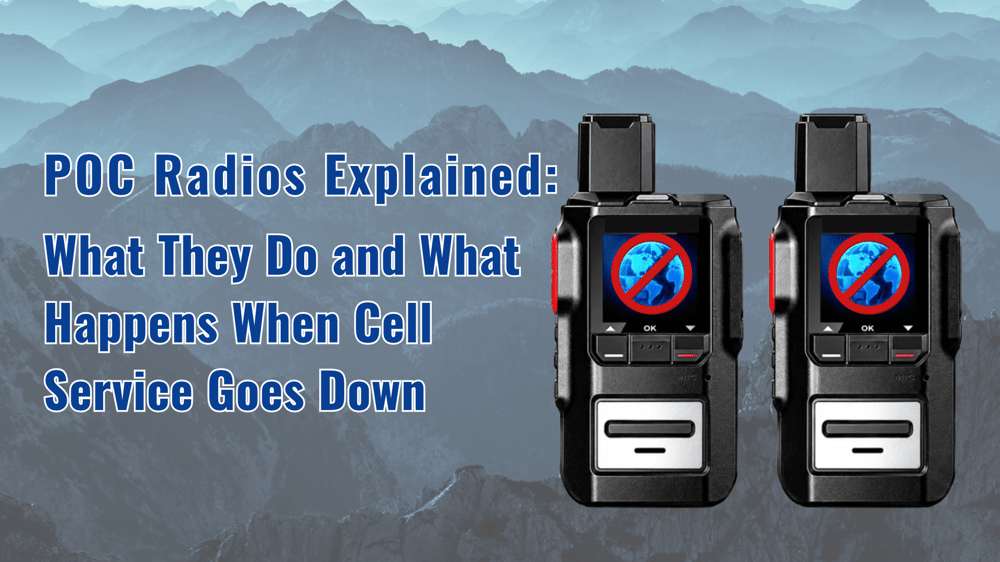
A POC radio is a walkie-talkie that talks over the cell network instead of over radio waves. It can reach across the country, but only where there is cell service. When the network goes down, it goes down with it.
That is the short version. POC radios are being advertised everywhere right now, and a lot of families are asking whether they are worth buying. Here is how they work, what they do well, and where they fall short.
I'm Caleb Nelson, K4CDN. I have been a licensed ham for more than 15 years and have spent more than 30 years in fire and emergency services.
What Is a POC Radio?
POC stands for push-to-talk over cellular. It looks and feels like a walkie-talkie, but inside it is closer to a phone. It has a SIM card, it connects to a cell tower, and your voice travels over the carrier's data network to the other radio.
That is why the ads say "unlimited range." There is no radio-to-radio link to run out of reach. If both radios have a signal, they can talk, whether they are across town or across the country. There is no license, no repeater, and nothing to learn beyond pushing a button. Brands you will see include Rapid Radios and Poclink, and they work in the same basic way.
What POC Radios Do Well
- Distance with no setup. Family in another state can be in the same group.
- No license. Nothing to apply for.
- Simple. Push, talk, release.
If your goal is staying in touch with people who are far away on a normal day, that is a real benefit.
The Catch: They Depend on the Same Things Your Phone Does
A POC radio needs a working chain, start to finish:
Break any link and the radio is a plastic brick. After Hurricane Helene, FCC numbers showed 370 of North Carolina's 1,452 cell sites out for lack of power, with another 103 running on backup power. In Buncombe County, about 82 percent of cell towers were offline a day after the worst of the damage. Verizon's own engineers pointed out that backup batteries and generators do not solve the problem when the fiber carrying the traffic is damaged.
That is the point people are making when they say these radios will not work if the grid goes down. A POC radio is not a bad idea. It just is not a grid-down plan on its own.
"Unlimited Range" Really Means "Unlimited Where There Is Signal"
The range claim is true in the sense that distance does not matter. It does not mean the radio works anywhere. Dead zones, rural stretches, and busy networks during an emergency all affect it. Even the companies that sell these radios say that coverage depends on the network.
Check the Fine Print on Cost
Some POC radios are sold as "no monthly fee." Look closely at what happens after the first period. Poclink's own site describes a yearly fee of about $50 per radio after the included service, and some Rapid Radios customer reviews mention a yearly SIM charge of about $50 per radio. Terms change, so check the current numbers before you buy, and multiply by the number of radios in your family.
What About the Backup Modes?
Some models add a short-range backup, such as a built-in FRS radio. One trade publication described that fallback as working within a few blocks. Others can connect over Wi-Fi, including Starlink. That helps in some situations, but Wi-Fi needs your internet to be working, and a few blocks is not a family plan.
Where a POC Radio Fits
Think of it as one layer of your plan, not the whole plan:
- Everyday use and travel. A fine way to keep a group connected while the network is up.
- Network down, family nearby. GMRS. It is a real radio that needs no tower, and the license has no test. One license covers your whole household. Expect a mile or two with handhelds, not 30. I explain the differences in GMRS vs FRS vs MURS.
- Network down, family far away. That takes a satellite messenger with an active plan on both ends, or ham HF with licensed operators and equipment on both ends. I compare them in GMRS vs Ham Radio vs Satellite Communication.
And ham radio is not plug and play either. Both ends have to match. I cover that in Why Ham Radio Is Not Plug and Play.
Before You Buy Any Radio, Answer Four Questions
- What happens when the cell network is down? If the answer is "it stops," what is the backup?
- Who needs to reach whom, and how far apart are they? Name the people.
- What does it cost per radio, per year, after the first year? Multiply by every radio.
- Does everyone know how to use it, and when do you check in? A plan beats a gadget.
That last question matters most. If you are not sure where to begin, start with Family Emergency Communication Plan: Where to Begin.
Frequently Asked Questions
Why Ham Radio Is Not Plug and Play
GMRS vs FRS vs MURS: Which Is Best for Family Emergency Communication?
Family Emergency Communication Plan: Where to Begin
AM/FM Transistor Radio Preparedness

Hi, I'm Caleb Nelson
Founder, Family Connect
I’m a husband, father of five, and a 30-year veteran of fire and emergency services.
I built Family Connect after watching too many families rely on systems they did not understand.
This platform teaches calm structure, clear roles, and practical communication planning for households that refuse chaos.

Turn What You Just Read Into a Plan Your Family Can Follow
The Family Connect System walks you through it in 29 short lessons: who contacts who, which channel comes next, and where everyone regroups. Running by Sunday night.

FamilyConnectSystem.com · CalebNelsonOfficial.com
© 2026 Caleb Nelson. Built from 30 years of emergency communications experience.